When shopping for new tyres, you’ve probably noticed the EU Tyre Label displayed on every new tyre sold in Europe. While most drivers glance at the coloured letters, few actually know what they mean or how much difference they can make in everyday driving.
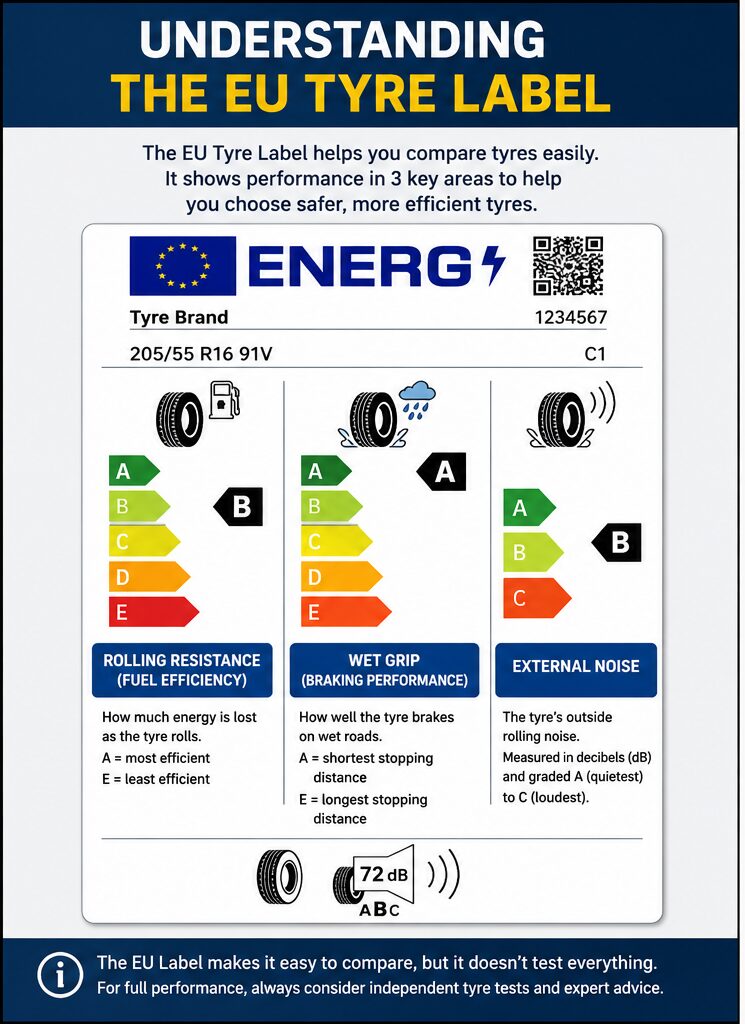
The EU Tyre Label is designed to help motorists compare tyres based on three key performance areas:
- Fuel Efficiency (Rolling Resistance)
- Wet Grip (Braking Performance)
- External Noise
Let’s break down exactly what each rating means and how it affects your driving.
1. Fuel Efficiency (Rolling Resistance)
Rolling resistance measures the energy required to keep a tyre rolling.
Every time your tyre rotates, it flexes slightly. Better-designed tyres lose less energy through this flexing, meaning your engine doesn’t have to work as hard.
The EU grades rolling resistance from A (best) to E (lowest).
How much difference does each grade make?
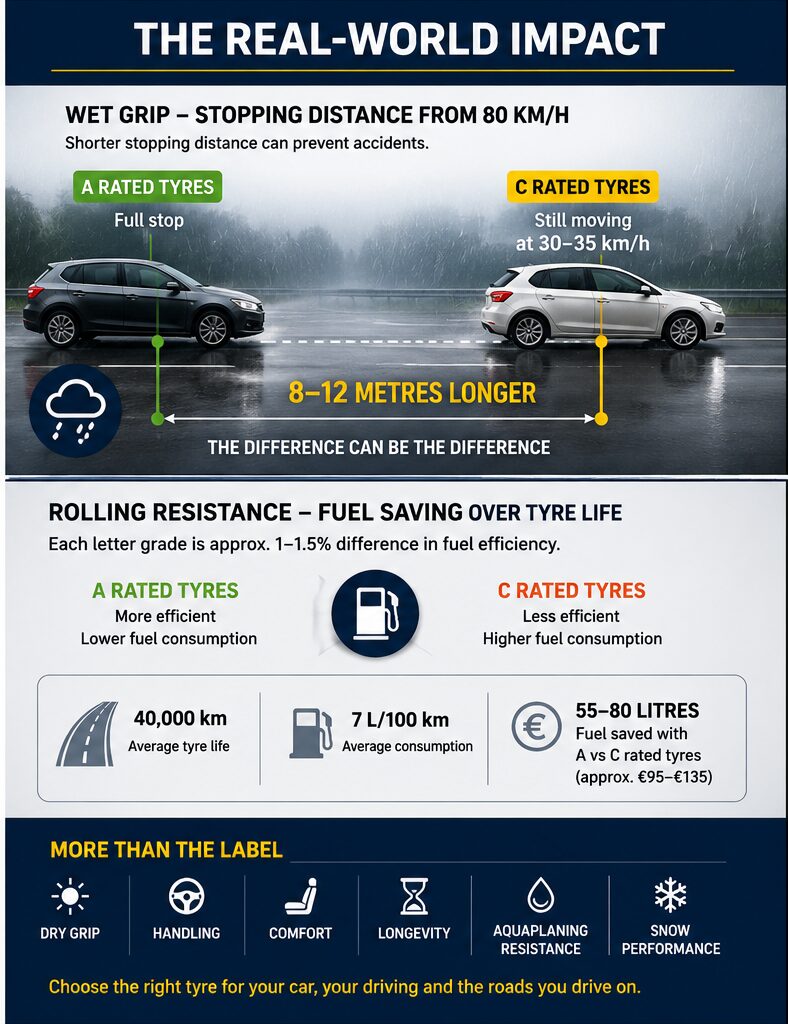
Independent testing shows that each step between ratings represents approximately a 1–1.5% improvement in fuel efficiency.
For example:
| Rating | Relative Fuel Consumption |
|---|---|
| A | Best |
| B | ~1–1.5% more fuel |
| C | ~2–3% more fuel |
| D | (Unused for passenger car tyres) |
| E | ~4–5% more fuel |
For an average petrol vehicle covering 40,000 km (approximately the lifespan of a quality set of tyres):
- Fuel consumption: 7 L/100 km
- Total fuel used: 2,800 litres
A tyre rated A instead of C could save approximately:
55–80 litres of fuel
At €1.70 per litre, that’s roughly:
€95–€135 saved over the life of the tyres.
Drivers covering higher annual mileage will naturally save even more.
Why don’t all premium tyres have an A rating?
This is one of the biggest misconceptions.
Many ultra-high-performance tyres deliberately sacrifice a small amount of rolling resistance in exchange for maximum grip and steering precision.
Performance tyres often feature:
- Softer rubber compounds
- Stiffer sidewalls
- Larger contact patches
- Increased cornering grip
These characteristics naturally create slightly higher rolling resistance.
In other words:
A tyre with a C fuel rating isn’t necessarily a worse tyre.
It may simply be engineered to prioritise:
- Sharper steering response
- Higher grip levels
- Better high-speed stability
- Improved cornering performance
This is why many sports cars leave the factory fitted with tyres rated B or C for fuel efficiency.
2. Wet Grip
Wet Grip is arguably the most important rating on the entire label.
It measures how effectively a tyre can stop on wet roads during emergency braking.
The EU grades tyres from:
A (Best) to E (Lowest)
What does each letter actually mean?
The difference between ratings isn’t just academic.
Each step typically represents a stopping distance approximately 3–6 metres shorter at 80 km/h under standardised test conditions.
Example
Imagine two identical cars travelling at 80 km/h.
Car A has A-rated tyres.
Car B has C-rated tyres.
When the A-rated tyres have already come to a complete stop…
…the C-rated tyres may still be travelling at approximately 30–35 km/h, and could still be 8–12 metres further down the road, depending on road conditions.
That’s roughly:
- Two family cars
- One pedestrian crossing
- An entire junction
In many real-world situations, that difference determines whether you stop safely – or have an accident.
Why Wet Grip Matters
Even if you mostly drive in dry weather, rain dramatically reduces available grip.
Premium tyres use advanced silica compounds and tread designs to:
- Disperse water more efficiently
- Reduce aquaplaning
- Maintain braking performance
- Improve steering response
This is why many premium brands consistently achieve A ratings.
3. External Noise
The final section of the label measures the tyre’s external rolling noise.
This is not the noise you hear inside your car.
Instead, it measures how much sound the tyre generates outside the vehicle.
The value is displayed in:
Decibels (dB)
Alongside a letter:
- A = Quietest
- B = Average
- C = Loudest (still legal)
Does a few decibels really matter?
Absolutely.
The decibel scale is logarithmic.
An increase of 3 dB represents roughly double the sound energy.
However, to the human ear, it sounds approximately 20–25% louder.
This means:
68 dB
is noticeably quieter than
71 dB,
even though the numerical difference seems small.
Does the EU Label Tell the Whole Story?
No.
The EU label is an excellent starting point, but it only measures three categories.
It does not evaluate:
- Dry handling
- Cornering grip
- Steering precision
- Aquaplaning resistance in corners
- High-speed stability
- Comfort
- Longevity
- Winter performance
- Snow traction
This is why independent tyre tests from organisations such as Auto Express, ADAC, Auto Bild and Tyre Reviews remain invaluable.
Many tyres receive identical EU ratings but perform very differently in real-world testing.
Choosing the Right Tyre
The “best” tyre isn’t necessarily the one with the most A ratings.
Instead, it should suit your driving style.
Daily commuting
Priorities:
- Fuel economy
- Comfort
- Low noise
Excellent choices often feature:
- A or B Rolling Resistance
- A Wet Grip
Family driving
Priorities:
- Wet braking
- Safety
- Long lifespan
A premium touring tyre is usually the ideal balance.
Performance driving
Priorities:
- Steering response
- Cornering grip
- High-speed stability
Don’t be surprised if these tyres carry:
- B or C Fuel Efficiency
They’re designed to maximise performance rather than absolute economy.
The Bottom Line
The EU Tyre Label makes comparing tyres easier than ever, but understanding what the ratings actually mean helps you make a far better buying decision.
Remember:
✔ Wet Grip is arguably the most important safety rating.
✔ Every improvement in Rolling Resistance can reduce fuel costs over the tyre’s lifetime.
✔ Noise ratings benefit both the driver and the surrounding environment.
✔ Premium performance tyres may have a lower fuel efficiency rating because they’re engineered to provide superior handling, steering response and grip.
At Tyreland, we believe the right tyre isn’t simply the one with the highest label rating – it’s the one that’s best suited to your vehicle, your driving style and the conditions you drive in every day.
If you’re unsure which tyre is right for you, our team is always happy to help you choose the perfect balance between safety, performance and value.